Year 3. Mathematics. Part B.
🧮 Year 3 Mathematics UASA Revision — Shapes, Measurements & Data (10–14)
1️⃣0️⃣ Fraction
Introduction: Fractions show parts of a whole. Students learn simple fractions (1/2, 1/3, 1/4, 3/4) and how to write and read them.
Explanation
Fraction form: numerator / denominator. Denominator = total equal parts; numerator = parts considered. Compare simple fractions with same denominators or use visual fraction models.
Examples
- Example 1: Shade 3/4 of a rectangle → 3 out of 4 equal parts shaded.
- Example 2: If a cake is cut into 8 equal slices and 3 are eaten → eaten = 3/8, remaining = 5/8.
- Example 3: Which is larger: 1/2 or 1/4? → 1/2 is larger.
Real-life word problem
Sam ate 2 slices of a pizza that was cut into 6 equal slices. What fraction did he eat?
Answer: 2/6 (which can be simplified to 1/3).
Tip: Use real objects (fruit, pizza, chocolate bars) to demonstrate fractions visually.
1️⃣1️⃣ Convert Units
Introduction: Converting metric units (length, mass, volume) and time is practical for everyday measurement tasks.
Explanation
Use simple conversion factors: 10 mm = 1 cm; 100 cm = 1 m; 1000 g = 1 kg; 1000 ml = 1 L; 60 min = 1 hour.
Examples
- Example 1: Convert 150 cm → metres: 150 ÷ 100 = 1.5 m.
- Example 2: Convert 2,500 g → kg: 2,500 ÷ 1,000 = 2.5 kg.
- Example 3: Convert 4500 ml → litres: 4500 ÷ 1000 = 4.5 L.

Real-life word problem
A bottle holds 1.5 L of water. How many millilitres is this?
Answer: 1.5 L = 1.5 × 1000 = 1500 ml.
Tip: Draw the metric ladder mm → cm → m → km to visualise jumps between units.
1️⃣2️⃣ Polygon
Introduction: Polygons are closed shapes with straight sides. Students learn names, side counts and simple properties.
Explanation
Common polygons: triangle (3), quadrilateral (4), pentagon (5), hexagon (6). Regular polygons have equal sides and angles.
Examples
- Example 1: Name a polygon with 5 sides → pentagon.
- Example 2: Identify: shape with 4 equal sides and 4 right angles → square.
- Example 3: Is a circle a polygon? → No (circle has no straight sides).

Real-life word problem
A stop sign is a regular octagon. How many sides does it have?
Answer: Octagon → 8 sides.
Tip: Count sides, not corners, to identify polygons easily.
1️⃣3️⃣ Location
Introduction: Learn simple grid references and coordinate reading (first value across, second value up).
Explanation
Use a labelled grid. Read (x, y) as x = column (across), y = row (up). Practice marking and reading points.
Examples
- Example 1: Point A at (3,2) → across 3, up 2.
- Example 2: On a 5×5 grid, mark (1,5) — leftmost column, top row.
- Example 3: If treasure is at (4,4), show its position on the grid.

Real-life word problem
A map uses grid references. A tree is at (2,4) and a bench at (5,1). Which is further to the right?
Answer: Bench at x=5 is further to the right than tree x=2.
Tip: Practice with battleship-style games to make learning coordinates fun.
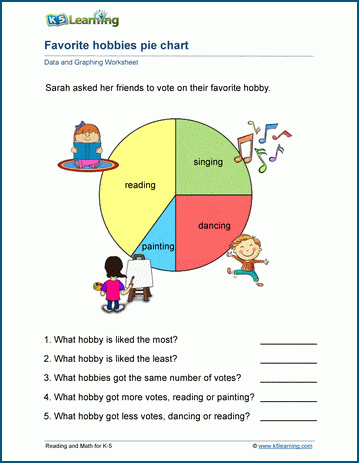
1️⃣4️⃣ Data (Pie Chart)
Introduction: Read and interpret pie charts — each slice shows a proportion of the whole (fraction/percentage/angle).
Explanation
Pie chart total = 360°. To find fraction: slice degrees ÷ 360°; to find percentage: fraction × 100%.
Examples
- Example 1: Slice = 90° → fraction = 90/360 = 1/4 (25%).
- Example 2: If apples = 40% and class has 30 pupils → apples = 0.4 × 30 = 12 pupils.
- Example 3: If pie chart shows 3 equal slices → each is 120° (360÷3).
Real-life word problem
A class votes for favourite sports. Pie chart shows Football 50%, Badminton 30%, Basketball 20%. If 40 students voted, how many chose Badminton?
Answer: 30% of 40 = 0.30 × 40 = 12 students.
Tip: Convert pie chart slices to simple fractions first, then to numbers if class size is given.
🌟 Final Exam Tips
- Practice with the activity book for exam-style questions.
- Use visuals (charts, place-value grids, number lines) while studying.
- Explain answers aloud — teaching helps learning.
📚 References & Official Links
- Curriculum Specifications — Mathematics Year 3 (KSSR Semakan) — BPK / MOE
- Mathematics DLP Year 3 — Part 1 (Digital Textbook example)
- AnyFlip — sample syllabus materials (search for KSSR Year 3 Mathematics)
© Ready for Blogger — Post B (Shapes, Measurements & Data). If you want printable PDF worksheets or answer keys for any topic, tell me which topic(s) and I will prepare them next.


Comments
Post a Comment